Danube Institute
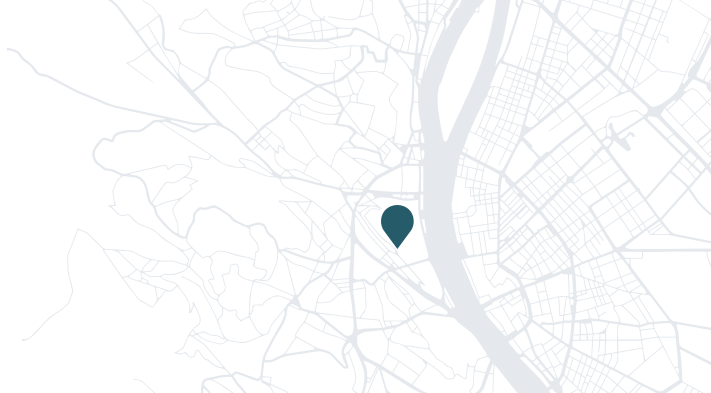
Office: Lónyay-Hatvany Villa - 1015 Budapest, Csónak St. 1.
Email: info@danubeinstitute.hu
Press: press@danubeinstitute.hu
Research
Drawing on fieldwork conducted among Christian communities in Iraqi Kurdistan and the Nineveh Plain, this paper examines the paradoxes of Christianity in contemporary Iraq and challenges simplistic narratives of religious persecution. While violence against Christians is often attributed to Islam itself, conversations with clergy, politicians, activists, and ordinary villagers suggest that the principal sources of instability lie elsewhere: in political collapse, foreign intervention, tribal dynamics, institutional dysfunction, and the unintended consequences of international aid.
The paper argues that many of the challenges facing Iraq’s Christians are shared with Iraqis more broadly and that external actors, from governments and aid agencies, to diaspora communities and churches, can inadvertently exacerbate local tensions. Rather than offering definitive conclusions, the paper raises questions about representation, development, and the assumptions that shape efforts to understand and support one of the world’s oldest Christian communities.
Office: Lónyay-Hatvany Villa - 1015 Budapest, Csónak St. 1.
Email: info@danubeinstitute.hu
Press: press@danubeinstitute.hu